Q If parts are broken, how can I resolve the issue?
A · Within the warranty period (e.g., one years): Record the issue on video and send it to the manufacturer. Their team will assist in troubleshooting. If the problem cannot be resolved remotely, a replacement part is typically sent free of charge.
· After the warranty period: Spare parts are usually offered at cost price for convenience.
-
Most machines arrive pre-assembled. You will primarily need to connect the wires and any additional components such as water pumps or vacuum pumps (if included with your specific machine). For machines requiring assembly, such as 4th-axis CNC models, comprehensive resources are typically provided to guide you through the process. This may include:
· Disassembly and Assembly Videos: Videos demonstrating the disassembly process at the factory, followed by a 360° video illustrating the assembly steps.
· Online and Telephone Support: Online and phone support for any assembly or setup questions. Furthermore, if you encounter problems, dedicated chat groups on platforms like WhatsApp, Skype, or WeChat may be set up, including sales, technical, and design team members for rapid resolution.
-
Various methods are available for learning to operate the machine and its software. CNC routers often come with tutorials providing detailed instructions. For further assistance, reputable CNC router manufacturers often offer training. Additionally, many online user groups provide tips and advice based on personal experiences. For comprehensive learning, hands-on classes are highly recommended. These classes teach machine setup, safe operation, and effective utilization of the software programs to translate ideas into physical results.
-
Common payment terms include:
· Initial deposit: Often 30% required before production begins.
· Remaining balance: Typically 70% due before shipment of the machine.
-
The manufacturing time for a customized serial-standard CNC milling machine typically ranges from 30 to 50 working days, depending on the specific series and any additional custom options. If the customer requires design changes to the product, the production period can extend up to 90 working days.
-
Production lead times can vary; for standard machines, it often takes 10 to 15 days, and for custom machines, 20 to 30 days.
-
Oil-free vacuum pumps provide a deeper vacuum and offer stronger holding power for processed materials, which is especially crucial when working with small products.
-
Oil lubrication primarily benefits sliders and guide rails. These components should ideally be lubricated with #46 oil every 4-7 days.
-
Daily machine maintenance often involves using compressed air or a vacuum cleaner to clear material debris. This applies to the guide rails, toothed guide rails, flexible cable circuits, and air-cooled spindles. Some manufacturers offer unique dust-free systems which can further reduce dust, extending machine life, protecting operator health, and improving production efficiency.
-
Consistent machine maintenance is crucial for maintaining production quality and preventing premature wear. Three key elements of CNC router maintenance include:
· Regular Greasing: The machine bearings and and rails require regular greasing to keep them lubricated.
· Regular Cleaning: Industrial CNC routers need daily cleaning to prevent chip and dust build-up in the control panel and other critical components.
· Replace Vacuum Filters: Vacuum pumps require periodic filter changes to ensure smooth operation of the vacuum motors.
-
The lifespan of a CNC router depends on factors such as diligent maintenance and frequency of use, in addition to the machine's construction grade. With proper use, a CNC router will typically last at least 10-15 years for smaller models and up to decades for industrial-grade routers.
-
English and Chinese languages are commonly supported.
-
Most software is compatible with all Windows systems, such as Windows 7, Windows 10, etc.
-
Commonly supported file formats include .nc/.u00/.cnc/.txt/.iso/.tap/.mmg/.plt.
-
Many machines support a wide range of software including Fusion360, AutoCAD, CorelDRAW, Ucancam, Cancam, ArtCAM, Type3, SolidWorks, and more.
-
No, you do not need to know specific programming languages to run a CNC router. While you use software programs to create your design, the design program automatically generates the necessary code (G-code) to control the machine. This allows for complete customization and edits without prior programming expertise, as the machine control software is typically user-friendly.
-
A CNC router relies on software to translate your design ideas into machine-executable instructions (G-code). This typically involves two main types: CAD (Computer-Aided Design) for creating designs and CAM (Computer-Aided Manufacturing) for converting those designs into machine commands. Many software solutions now combine both CAD and CAM functions. Some manufacturers provide software when you purchase a machine, though specialized post-processors for 4-axis or 5-axis machines might have an additional cost. You can also use your preferred compatible software.
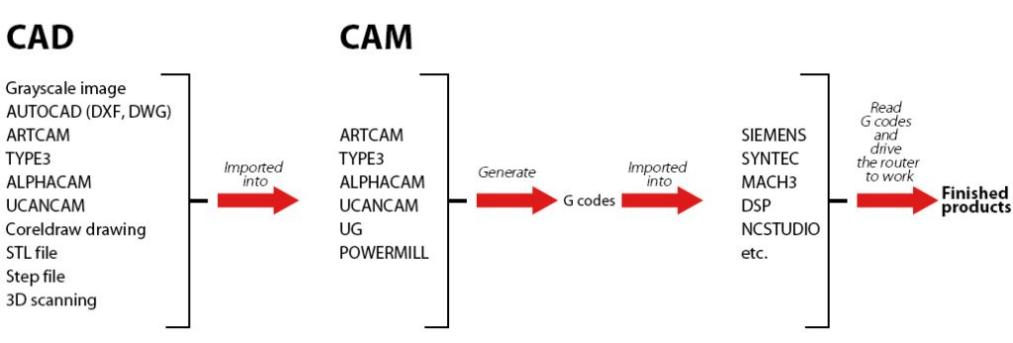 Common examples include ArtCAM, SolidWorks, CorelDRAW, and Powermill.
 -
Bit breakage during CNC processing can occur due to several factors. If this problem arises, you can systematically check your machine and process. Understanding the potential causes can help you prevent tool breakage in subsequent operations.
-
The cutting, engraving, milling, and other operations of a wood router machine are all performed by the bits. Choosing the correct CNC router bits is crucial for improving work efficiency and ensuring precise processing results. While various types of bits exist, here are recommendations for different materials and applications. Keep in mind these are general guidelines, and specific bit selection should be based on the actual processing situation:
· Acrylic Cutting: Single-edged spiral cutters are recommended. Double-edged milling cutters or cylindrical cutters can also be used for thin acrylic sheets.
· Aluminum Machining: Dedicated single-edged aluminum CNC router bits are recommended. Double-edged milling cutters designed for metal can be used for less stringent cutting requirements or harder aluminum sheets.
· Engraving Relief Patterns (Non-metal): Round bottom CNC router bits are primarily used for this purpose.
· Softwood, MDF, Original Wood, PVC, Acrylic Engraving: Single- or double-edged spiral milling bits can be used.
· Metal Engraving: Tungsten steel-coated, metal-specific single- or double-edged milling cutters, and special flat-bottomed bits are recommended.
· MDF, Solid Wood, Multi-layer Board, Plywood Processing: Straight groove milling cutters or double-edged large-flute milling cutters are suitable.
· Jade or Stone Engraving/Carving: Diamond engraving CNC router bits are a good choice.
-
Transmission systems convert motor rotation into linear movement.
· Rack and Pinion:
o An upgraded transmission method known for high speed and lower environmental sensitivity.
o Compared to ball screw drives, rack and pinion drive on the X-axis and Y-axis (often combined with a Z-axis ball screw drive) offers a relatively long service life.
o Suitable for large-scale CNC wood engraving machines, easy to maintain, and often equipped with a manual oiling system.
o Primarily used for processing woodworking products, such as doors, cabinets, screens, and for plate cutting, hollow carving, embossing. Can also be used for processing stone, marble, and granite.
· Ball Screw Rod:
o An original transmission method characterized by high precision but typically slower running speeds.
o Often has higher environmental requirements and a relatively shorter lifespan.
o The Y-axis should not be excessively long (meaning the machine model should not be too large).
o Mainly used in advertising, wood products, small handicrafts, pumice, and similar applications. Any material can be engraved depending on the router tools used.